
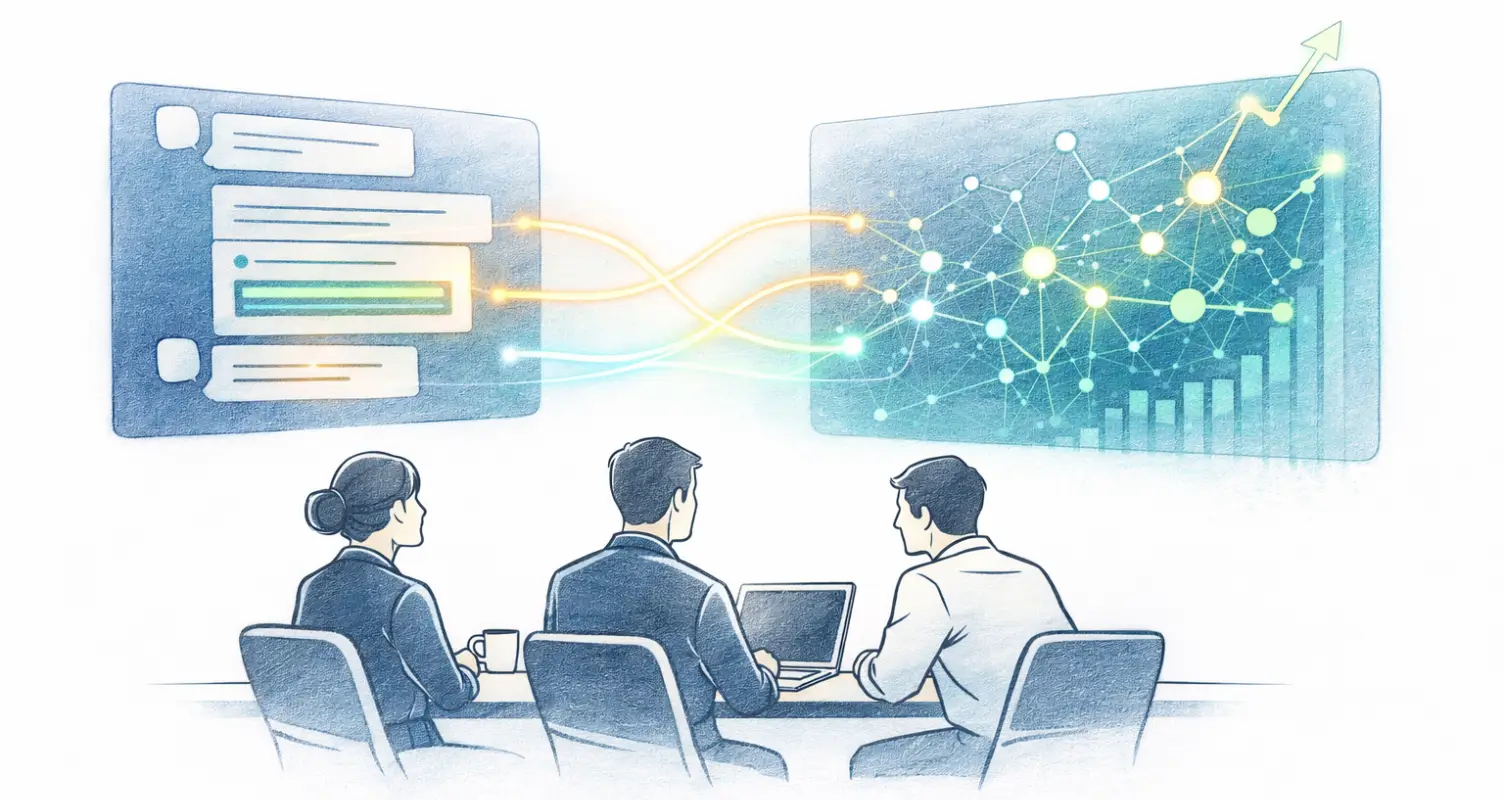
From Invisible to Cited: How EchoLynk Achieved 8.4x Lead Conversion Through ChatGPT Optimization
Buyers who know what they need have started skipping Google. They ask ChatGPT, Perplexity, and Gemini instead. Traditional search still works, but a parallel channel has opened up, and the traffic coming through it behaves in ways we didn't expect.
We got to test this with EchoLynk. We'd been building our Answer Engine Optimization (AEO) and Generative Engine Optimization (GEO) approach for a while, and EchoLynk was the right project to prove it out. AI-referred traffic appeared as early as week 2. Over 4 months, the numbers built into something we had to double-check: an 8.4x increase in lead conversion rate, with engagement metrics up across every dimension.
This study covers what we did, what the numbers look like, and what we think it means for businesses paying attention to where search is heading. No magic budget required. No perfect starting position. EchoLynk's product was invisible to AI before we started. Four months later, it wasn't.
The Bigger Picture: Search Is Splitting in Two
Gartner predicted traditional search volume would drop 25% by 2026 as AI chatbots replace conventional queries[1]. That prediction is playing out. ChatGPT processes over 2.5 billion queries per day. Similarweb reports over 5.7 billion monthly visits as of early 2026[2]. Conductor found that 87.4% of all AI referral traffic across major industries flows through ChatGPT[3]. Gartner's latest forecast goes further: by 2028, traditional search traffic could decline by 50%, with 90% of B2B buying decisions running through AI agents[9].
When someone asks ChatGPT "what's the best tool for X," they don't get 10 blue links. They get one answer. Your business is either in that answer, or it doesn't exist to that person.
AEO and GEO involve a different set of signals than Google's ranking algorithm rewards. There's overlap with SEO, but the core mechanics are distinct. SEO gets you blue links. AEO and GEO get you cited as the answer.
Why AI-Referred Visitors Behave Differently
Traffic from ChatGPT and other LLMs doesn't just come from a different source. It comes from a different mindset. This clicked for us once we saw the data.
A typical Google searcher types a query, gets a page of results, clicks a few, bounces between tabs, reads comparisons. They arrive on your site in exploration mode. Still figuring things out.
Someone asking ChatGPT gets a different experience. The AI considers their needs, weighs options, and gives a direct recommendation with a link. By the time that person clicks through, the AI has already done the comparison shopping for them. They land on your page at the end of their research funnel, not the beginning. Higher trust. Clearer intent. A reason to be there.
The industry data lines up. Microsoft Clarity studied over 1,200 websites and found AI-sourced visitors 3x more likely to take action (subscribe, sign up) than organic search visitors[4]. Similarweb's 2026 data: ChatGPT-referred users spend 15 minutes on site versus 8 for Google referrals, view 12 pages versus 9[2]. Contentsquare: visitors from generative AI results stay 8% longer, view 12% more pages, and are 23% less likely to bounce[5]. Semrush: shoppers arriving through AI platforms have visits 38% longer than traditional search[6].
What Happened with EchoLynk
EchoLynk had a strong product and a well-built website. But when we tested how major LLMs responded to queries in their space, the brand wasn't mentioned. Not once. The content was fine. Domain authority was fine. The AI models just didn't know EchoLynk existed in the context people were asking about. We got to work. Within 2 to 3 weeks, ChatGPT-referred traffic appeared in the analytics. Over the following 4 months, engagement and conversion metrics built into the numbers below:
| Metric | Improvement |
|---|---|
| Views per Active User | +14.99% |
| Average Engagement Time per Session | +86.47% |
| Average Engagement Time per Active User | +57.52% |
| Event Count per Active User | +18.41% |
| Engagement Rate | +53.45% |
| Engaged Sessions per Active User | +29.63% |
| Lead Conversion Rate | 42% vs 5%. 8.4x increase (740% lift) |
The engagement numbers tell the story as much as the conversion rate. Visitors stayed 86% longer per session. They read, scrolled, explored. The 53% engagement rate lift confirms they interacted with the content, not just scanned it. These people showed up with a reason to be there.
The conversion number made us sit up. 42% versus the previous 5%. We believe it traces back to funnel position: by the time someone clicks through from ChatGPT, the AI has already done much of the convincing. The visitor arrives with context, trust, and a clear next step in mind. Not starting research. Finishing it.
The Timeline Surprised Us Too
SEO work takes 3 to 6 months before you see movement. Google's crawl-index-rank cycle is just slow. So when we saw the first ChatGPT-referred visits landing on EchoLynk's site within 2 to 3 weeks of starting, that was unexpected. The full results came over 4 months. But that early traction signaled the approach was working.
In hindsight it makes sense. LLMs don't follow Google's timeline. No waiting for domain authority to build or backlinks to age. When the right signals are in place (and getting them right is where the craft comes in), the models respond fast. They either see your brand as a credible answer or they don't.
To be clear: the 8.4x conversion lift and the 86% engagement increase reflect 4 months of sustained work and accumulating data. But the feedback loop runs faster than traditional SEO. EchoLynk had high-quality traffic at a point where a conventional SEO campaign would still be warming up. That speed is structural. Any business working in this space can take advantage of it.
An Honest Look at What This Means
SEO isn't dead. But the numbers make a parallel channel hard to ignore. ChatGPT has over 800 million weekly active users[7], and the number keeps climbing. That's a lot of conversations where businesses are either being recommended or overlooked.
A fair question: "Isn't this just SEO with a new label?" We thought the same thing early on. The more we worked with LLMs, the clearer it became that they respond to different signals than Google's algorithm. Some of EchoLynk's competitors held solid page-one Google positions but had zero visibility in AI-generated answers. That gap convinced us this was a separate discipline worth learning.
One more thing we've observed: once an LLM starts recommending a brand, it tends to keep doing so. The authority builds on itself. Businesses that figure this out early gain a structural advantage. The techniques aren't impossible to replicate, but being first to establish AI-side authority creates a position that gets harder to displace over time.
Putting the Numbers in Context
To make the conversion number concrete: 100 AI-referred visitors to EchoLynk produce 42 leads. At the previous 5% rate, those same 100 visitors produced 5. That's a different pipeline.
The engagement metrics matter too. Visitors who spend 86% more time on your site absorb more of what you offer. They reach the sales conversation better informed, with fewer objections and a clearer sense of fit. In our experience, that translates into better close rates and longer customer relationships, though we'd need more time with EchoLynk to confirm the pattern holds here.
The trajectory is hard to ignore. Microsoft Clarity measured 155.6% growth in AI referral traffic over 8 months across 1,200+ sites[4]. Gartner's 25% search decline prediction is showing up in real traffic data[1]. You can see this in your own analytics if you're tracking it. The opportunity is open to any business willing to invest the time.
What We Can Share About Our Approach
The general principles of AEO and GEO aren't a secret. What matters is how you combine, sequence, and adapt them to a specific situation. That's where results come from, and that's the part that's hard to commoditize.
At a high level, our work with EchoLynk touched on a few key areas:
- •Understanding the starting position We mapped how major LLMs responded to queries in EchoLynk's space before changing anything. Where did the brand appear? Where was it absent? What were the models citing instead? This baseline shaped everything that followed.
- •Building the right signals LLMs form their understanding of a brand from structured and unstructured data. Getting that data to represent who you are and why you're credible has technical, content, and authority components. They need to work together.
- •Testing across models ChatGPT, Perplexity, Gemini, and Claude don't think the same way. What works for one might not register with another. We test across all of them and adjust.
- •Staying current AI models update often. What works today can shift. Ongoing attention is part of the equation.
What ties all of this together is something we invested heavily in before touching any client work: we spent time reverse-engineering how the most popular LLMs, including ChatGPT, Gemini, and Grok, prioritize and surface content in their responses. Each model weighs sources differently. Each one has patterns in how it selects what to cite, what to summarize, and what to recommend. Understanding those patterns at a deep level is what lets us build signals that actually move the needle, rather than guessing at what might work.
We've turned that research into specific methods and tools through trial, iteration, and testing. We won't pretend we publish every detail. Some of what we've learned is hard-won and forms the backbone of our approach. The core idea is straightforward: make your brand the most credible, most complete answer an LLM can give. How you get there is where the craft lives.
What We Took Away from This
The EchoLynk project confirmed what we'd been suspecting: a growing pool of high-intent traffic exists that most businesses aren't aware of, let alone optimizing for. 8.4x lead conversion. 86% longer sessions. Measured over 4 months with early traction visible in weeks. All tracked in standard analytics.
We don't think these results are unique to EchoLynk. Any business with a solid product and an audience that uses ChatGPT (800 million weekly users, so most audiences) can benefit from this kind of optimization. The techniques are learnable. The timeline is fast. The traffic quality speaks for itself.
There's a real difference between understanding the principles and knowing how to execute them well. We've spent a lot of time on the second part, and we're still learning. If you're curious about where your business stands in AI-generated answers, that's an easy thing to find out and a good place to start.
Curious where your brand shows up in AI answers?
We'll run a quick AI Visibility Audit. No commitment. Just a clear picture of where you stand and what the opportunity looks like.
Get a Free AI Visibility CheckReferences
- [1]Gartner. (2024). Gartner Predicts Search Engine Volume Will Drop 25% by 2026, Due to AI Chatbots and Other Virtual Agents
- [2]Similarweb. (2026). Generative AI Statistics for 2026 — Traffic, Engagement & Market Share
- [3]Conductor. (2025). ChatGPT Drives 87% of AI Referral Traffic Across Industries
- [4]Microsoft Clarity. (2025). AI Traffic Converts at 3x the Rate of Other Channels (Study)
- [5]Contentsquare. (2026). How Digital Traffic is Changing in 2026 — Digital Experience Benchmark
- [6]Semrush. (2026). 26 AI SEO Statistics for 2026
- [7]DemandSage. (2026). ChatGPT Users Statistics — Global Growth & Usage
- [8]Digiday. (2025). In Graphic Detail: The State of AI Referral Traffic in 2025
- [9]Gartner. (2025). Top Strategic Predictions for 2026 and Beyond